
The Modern Way to Build a Product Design CV That Gets You Hired
You’re a product designer and you didn’t get hired after submitting 300 applications. Now you’re wondering what’s going wrong. Part of it could be your CV.
You’re a product designer and you didn’t get hired after submitting 300 applications. Now you’re wondering what’s going wrong. Part of it could be your CV.

Tyler and I get CV-related questions from our audience a lot. Most of them are just your typical ‘can you review’ question. When we do, we see a lot of the same things: unclear structure and case studies that just aren’t quite it.
We’re going to discuss those observations in this article, but first, let’s talk about the current state of product design CVs.
Today, everyone’s generating CVs while companies use AI to review them. Isn’t that sad? The interesting problem is that all CVs are starting to look the same. Generating them makes us all move to a safe middle ground. We also lose our connection to our CVs because we don’t really work on them anymore.
It’s also where your biggest opportunity lies. Remember: if everyone has access to the same tools, success comes down to what you can achieve with those tools.
Take your CV: it’s all about you. It’s all about attention and standing out. You’ll have to accept that and go the extra mile. Good isn’t good enough.
To go the extra mile, we should build a solid foundation first. That’s why we’re going to start with a few dos and don’ts before we talk about what Tyler ran into when he tried to hire a product designer a while back.
There are tons and tons of dos and don’ts available online around fine-tuning your product design CV, and I don’t want to waste your time mentioning all of them yet again. However, I do think there are a select few essential dos and don’ts for your CV that I want to briefly touch on here before looking at Tyler’s experience hiring someone and what that teaches us.
First of all, I want to touch on structure. As a product designer, you already have the design hard skills to set up a solid structure and layout. Your CV should reflect that.
Like your website, your CV is one of your ‘first products’. The way you handle those products is a direct mirror of how you would handle the product design projects someone might hire you for. So, if your CV is a mess, it will subconsciously tell the hiring manager that you work in a messy way. That’s not the message you want to send.
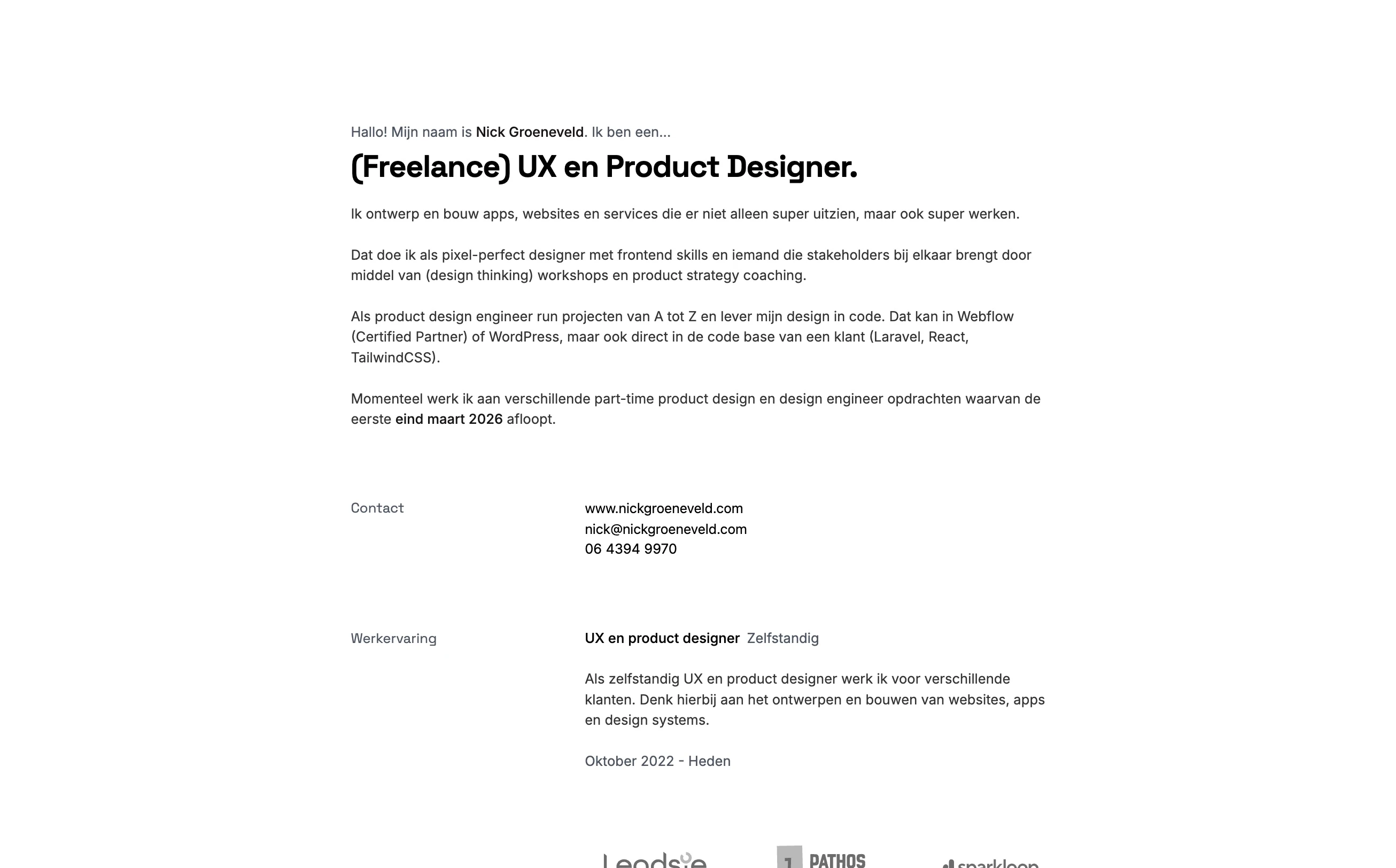
So keep it simple. Use a single-column layout with clear spacing where everything is easy to read and digest. The image above shows an example of what a well-structured CV looks like.
There’s enough spacing to make everything easy to read and everything that belongs together sits together. In terms of Gestalt principles, this CV makes sense.
Up next are case studies. You write these about your work experience. They make up the majority of your CV and are the most important part. In the case study header, highlight your role first and the ‘where and when’ second.
Senior UX designer – [company name] – 2021–2023
The overall strategy here is that you want to mention your role multiple times, in places high in the hierarchy, so it’s super obvious what your role is when a hiring manager scans your CV.
With the header in place, write a single paragraph for each case study where you mention your position, what you did, and the result.
“As a senior UX designer, I redesigned a mortgage calculation tool and user flow for a large bank. As a result, the conversion rate went up 4 percentage points and customer service waiting times dropped by a week.”
The above is an example from my CV and website. It is a project I worked on a few years back, and as you can see, I clearly focused on what I did and the results that came from it. That’s all you need to do for the case studies you put in your CV. Nothing more, nothing less.
I just want to see craft. Now I want to see thinking. And then I want to see experience.
Interviews where you just have to repeat things the hiring manager already knows are the worst. You want them to ask you questions you easily know the answers to. If you leave out some details you know well, chances are the hiring manager will ask you about them. That way you keep control of the conversation.
I know this looks a few steps beyond the CV we’re working on, but that kind of preparation is what makes all the difference for your overall odds of landing a product design job.
And finally, a few things I would stay away from. I’m going to keep this short and specific.
One thing that’s been working great for me recently is to have my CV as a single-page website. On it you’ll find my full CV, with contact options, ways to download the CV, and a ‘last updated’ indicator. Take a look at mine here.
Whenever I talk to a recruiter and they ask me to send over my CV, I can just send over a link to the website instead of looking for a file that’s lost somewhere on my computer. It also makes a great impression. Where most designers just send over a file that gets lost, you’re the one with a dedicated domain for your CV. It’s pretty cool.
Now, this is a great idea for initial recruiter calls and overall networking. As Tyler mentions in the episode below, though, it doesn’t work when a company requires you to submit a PDF.
That being said, having a central place for your CV makes a lot of sense. People can also just find it without having to go through you first. It’ll help you with ‘inbound’ leads (freelance) and recruiters finding you (in-house).
If you don’t want to do this yourself, there’s also a done-for-you option called Self. It’s a very interesting concept where you upload your current CV and they turn it into a website for you. They have tons of extra features like analytics and other useful stuff. Take a look.
I spoke to Tyler recently about his experience hiring a product designer. What stood out the most to me was the order in which he decides whether or not you get an invite for an interview. I’d never thought about it this way myself, and it does change the way I would structure my CV.
Here’s what Tyler looks for.
When judging a product designer, Tyler wants to see your portfolio website. The big takeaway for you here is to make sure it’s super easy to find within your CV. Put a link or a button that’s really in-your-face in the top area of your CV. The most obvious place would be the end of your intro section.
Once Tyler lands on your portfolio website, he looks for case studies. Within a case study, he wants to see the following in order:
This is the extended version of that one-paragraph summary I mentioned earlier in the article. As you can see, there’s nothing fancy about it. There’s nothing about UX workflows, sitemaps, and all the other things you learn in a bootcamp. He wants to see the impact you made as a designer.
If all of the above checks out, he goes back to your CV to look at the remaining checks you have to pass. These include your other case studies, your location, and your education. From your case study, he already knows (and likes) the way you work, and now he wants to confirm you’re a good fit by looking at the little things.
Let’s start by applying everything you’ve read in this article. Make sure the structure of your CV is correct, that you have a super strong single-paragraph summary for each case study, and that it’s easy for your readers to go from your CV to your portfolio.
Once all of that is done, it’s time to test out your new CV. Treat it just as you would any design project. You have your baseline performance from the last 30–60 days with a certain number of callbacks. Attach a conversion rate to it by dividing the total number of callbacks by the total number of applications sent.
If you don’t have that baseline, go by feel: how much have you been getting back from your applications so far?
Then, do the same while using your new CV for the same 30–60-day period. Did you get more callbacks? Or fewer? Analyze it, fine-tune based on what you are getting back, and repeat.
In this episode of The Design Table Podcast, Tyler and Nick reveal what actually happens on the hiring manager's side of 300 product design applications. Tyler shares his exact review flow and why your portfolio gets judged before your resume is even read. Are you being skipped for reasons you can fix today?


Join a private network of UX and product designers learning and building a design career together.


A podcast for designers looking to get a seat at the table and learn how to build a successful (freelance) design career. New episodes every two weeks.


