How a Product Design Director Uses AI to Explore 10 Ideas At Once
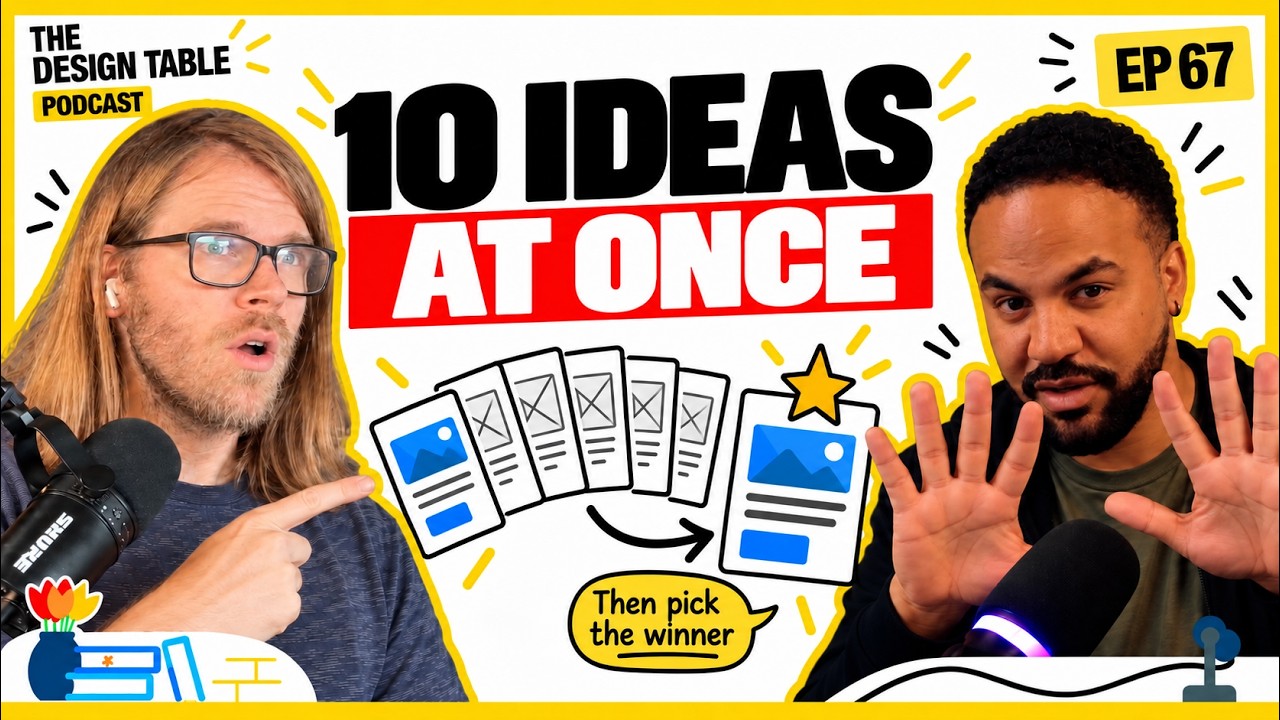

Watch & Listen:


Design school taught us you should explore before you settle on a solution. In reality, most designers sketch two or three options, pick one, and hope nobody asks about edge cases or anything outside of the 'happy flow'. Now that prototyping is so much more accessible, going wide has never been easier. With that in mind, why are so many designers still designing for that happy flow only?
In this episode of The Design Table Podcast, Tyler and Nick talk about conceptual range and depth: going wide to find better design solutions before going deep one that one solution to bring it up to standard. They take down the "double diamond is dead" takes you read everywhere else and focus on the real day-to-day workflow of a modern product designer.
Tyler walks through his full process, step by step. He asks Claude for ten variations of a concept in a single prototype with a toggle to switch between them, shares it live with engineering and product, and narrows down from there. Before making any prototype, he maps the flow and edge cases in FigJam. Then he uses a GitHub connector to check his ideas against the real app, and the Figma agent to turn screenshots into design system-ready files for handoff.
Like always, Nick is more reserved. He shares what he learned from the Interface Craft course, why context switching while AI works is exhausting, and the risk of anchoring too hard on the design you already have. On one project, it took a developer with a completely fresh idea to break the team out of weeks of going in circles.